Wednesday, January 17, 2018

Hahahahaha – giggle – snort – hmmmm


Flowers in my yard.
This was a post I wrote back in October.  I had all sorts of flowers blooming.  It was nice.


 So, I thought I’d follow it up today with another post about the yard.  It wouldn’t be completely unusual to have pansies, alyssum, ground orchids, buttercups, roses – all budded out or even blooming.  Of course, we have had more winter this season than the past bunch of years …..
Late January 2017

January 2018 – Flowers in my Yard.

First of all – I don’t usually mind winter.  Gives me and my yard a time to relax.  Of course, we haven’t had much winter over the past 15 years.  For the most part winter tends to be 60° highs and 40° lows with the odd freeze or two.  That works for me.  Mostly, we’ve had a bunch of “winter” months where it was necessary to turn on the AC.  I don’t like that too much.  Yesterday we had a Dallas-type ice storm.  Temps never got above 30°, it was overcast, and it sleeted off and on all day long.  I can’t even remember the last ice storm we had here. 


OK - What's in my Yard?  Well, first of all, when I went outside at 10:30am, the temperature was 28°.  That’s warmed up from 19° when I got up this morning.  That’s just wrong.  I live in the Gulf Coast Plains.  I’m pretty sure it’s not supposed to be 19° - ever.  Then, the ground crunched under foot – crunched as in walking on ice covered grass.  Everything is still covered in ice although at a balmy 28°, it is melting – sort of. 


Pretty Amaryllis in Oct 2017


not so pretty Amaryllis

Ice covered Bromelaid


No Ginger this year


Ferns

Aloe - looks good
Nope, completely encased in ice.
Will be mush later today.

Positive thoughts here - Could be worse – could be this cold will last until April.  However, by Saturday (that’s 2 days from today, Saturday) it’s going to be 75°.  While most of my herbs are frozen flat, the oregano and rosemary look fine.  The roses should be fine.  Everything else?  Pretty much done.  Well, gives me a chance to try new things.

Take care.

Tuesday, January 16, 2018

And, more books


Today, at my house, the weather is awful, terrible, icky, rainy, icy, and COLD.  This is a day to bundle up and read.  If you are looking for something, try any of these.  They are some of the ones I read during my teen years and again as an adult.  They can touch your heart, make you think, and I recommend every one of them.

The Tall Woman by Wilma Dykeman 1962
From the North Carolina hills comes the story of Lydia Moore who married Mark McQueen, and whose life, from 1846 to 1896, encompassed the privations of the Civil War, the hardships of the reconstruction period, and the view of a future that was possible for her children. Lydia accepts Mark’s decision to fight for the Union while her father and brother join the South. The story is about how Lydia gives generously of herself and her abilities, about their children, her brothers and sisters, and all the friends along Thickety Creek.  About all the things that contribute to the growth of a woman who casts a long shadow, who works for education, for a way of life she has never known, and for the strength of a marriage.
Plainspoken as its subject this is a record without artifice that is, however, artful in its simplicity. That market, tired of the overindulgence of flesh, of sex and of extra explicitness, will be relaxed and refreshed with this. Kirkus Review


This book belonged to my mother.  In my mid-teens I found it and read it.  It had everything necessary to appeal to my teenaged heart.  I still have the book and I’ve read it more than once.  It appeals to my adult heart too.

All This, and Heaven Too by Rachel Field
Written in1938, this novel is based on the true story of one of the most notorious murder cases in French history.  It takes place in the mid-1800’s.  Henriette Deluzy-Desportes was hired as governess to the children of Charles Laure Hugues Théobald, Duc de Choiseul-Praslin and Fanny Sébastiani, Duchess de Choiseul-Praslin.  There are hints of an attraction between the governess and Duc.  The Duchess thought Deluzy-Desportes was trying to estrange her children from her and fired the her.  This led to the Duc murdering his wife.  Henriette Deluzy-Desportes was implicated and had to plead her own case before the Chancellor of France in a sensational trial that caused a major scandal which in turn contributed to the outbreak of the 1848 revolution and fall of the monarchy.  After Deluzy-Desportes was freed she left France for America and married Henry Field, author Rachel Field’s uncle This thrilling historical romance, full of passion, mystery, and intrigue, has laid claim to the hearts and minds of readers for generations.

Naked Came I by David Weiss, 1963
This is about the life of Francois Auguste Rodin and portrays him as a man and artist, driven to be perfect because his temperament would allow him to be nothing else. Friends with other Parisian artists such as Degas, Renoir, Manet, and others associated with the Salon des Refusés, these artists were generally outside the Paris art establishment and refused admission to the École des Beaux Arts. The book’s title is taken from a quote from Don Quixote by Miguel de Cervantes –
“Naked came I into the world,
and naked must I go out.”

Five Smooth Stones  by Ann Fairbairn
This is a story of civil rights.  It is about David Champlin,a black man born into poverty in Depression-era New Orleans who achieves great success then sacrifices everything to help people in the difficult, day-by-day struggle of the civil rights movement. It is about Sara Kent, the beloved and vital white woman who loved David from the moment she first saw him. It about their struggle over David's belief that a marriage for them would not be right in the violent world he had to confront.

The “five smooth stones” are those the biblical David carried against Goliath. First published in 1966, this epic has become one of the most loved American bestsellers.  Goodreads

Take care.


Monday, January 15, 2018

Books


I love to read and have as long as I remember.  
So, here are some of my favorites during different times …..

As a child, I read, a number of the Oz Books by L Frank Baum.  I wish I could say I still had them, however they were passed down to my sister and brother.  Then, when my mother determined we were too old for certain books, she collected them and gave them away.  Good thing/bad thing.  Today, I have a small collection of children's books, some I read, some my children read.  I like books.


So, like the world at large, I read the first book - The Wonderful Wizard of Oz.  Everyone know what it’s about – Dorothy and her dog Toto are swept away in a cyclone to the Land of Oz.  All she wants is to return home and is directed to the ruler of Oz, The great and powerful Wizard.  On the way to the wizard, she meets Scarecrow, Tinman, and the Cowardly Lion.  Everybody learns something about themselves and Dorothy ultimately gets home. 


When I got ready to write this piece, I looked up the Oz books.  There are 14 - written from 1900-1920.  I don’t recall all of them, but I do (sorta – been a year or two) recall these.

The Marvelous Land of Oz. 
Ozma of Oz
Dorothy and the Wizard in Oz
Tik-Tok of Oz
The Scarecrow of Oz
The Tin Woodman of Oz


I also read several of the Happy Hollisters books by Jerry West (a pen name for Andrew Svenson).  These books, written in the early 1950’s, were about the Hollister family.  The family has fun adventures together, and when mysteries arise, the five children become amateur sleuths and are allowed to investigate and solve the mysteries on their own.


And, of course, I read many of the Nancy Drew books by Carolyn Keene (and here is something I didn’t know until today, these books, along with The Hardy Boys books were written within the Stratemeyer Syndicate.  It was a customary practice to assign pen names to various book series so more than one author could write for the series.  So, while a number of authors actually wrote the Nancy Drew books, they all used the pen name Carolyn Keene and for the Hardy Boys, used Franklin W. Dixon).  Something to add to your file of strange and weird information.


The Nancy Drew Mystery Stories series was begun in 1930 and ended in 2003.  In the books I read, Nancy is a 16-year-old high school graduate, living in the town of River Heights with her father, attorney Carson Drew, and their housekeeper, Hannah Gruen. As a teenager, she spends her time solving mysteries, some of which she stumbles upon and some of which begin as cases of her father's. Nancy is assisted in solving these mysteries by her two closest friends and cousins, Bess Marvin and George Fayne and occasionally by her boyfriend Ned Nickerson, a student at Emerson College.  And Nancy was everything a girl could want to be – a fine painter, skilled driver, a sure shot, excellent swimmer, skillful oarsman, expert seamstress, great cook, fine bridge player, played tennis, golf, danced like Ginger Rogers and could administer first aid like the Mayo brothers.  Plus she solved mysteries!  What's not to love.


There were others of course but these still stand out as favorites in my childhood memory.  Tomorrow, teen years.

Take care.


Friday, January 12, 2018

The Herbs of 2017 and 2018


I had every intention of publishing a piece on the 2017 Herb of the Year – Cilantro/Coriander.  Which didn’t happen.  So, I’m going to take a quick step back to 2017.  And, did you know …

An annual, Cilantro/Coriander is a favorite in many gardens.  It grows best in partial sun or as a late fall/early spring plant (at least here – it doesn’t care too much for our summer heat and humidity) in a well-drained soil.  The cilantro leaves can be harvested when the plant has reached its mid-growth.  It  will flower with tiny fragrant pinkish white blooms and then go to seed (Coriander). This a is two-for-one plant.  If not picked for the seed, this plant is a reseeder and will pop back up next spring.

This is one of the world’s oldest known herbs and has been cultivated for over 3,000 years.  The ancient Egyptians believed coriander could be used in the afterlife as a food and the seeds have been found in Egyptian tombs.

It is most often used in Mexican, Asian and East Indian dishes. All parts of the plant are edible, but the fresh leaves and dried seeds are most commonly used. The roots of the plant are an important ingredient in Thai cooking where it is minced and used in salads, curries and relishes.  The leaves are best used fresh as drying will cause a loss of flavor.  Add at the end of the cooking time to maintain flavor.  Leaves are great to use with tomatoes and peppers for salsa, added to salads, scrambled into eggs, included in guacamole, hummus, pesto sauce, fish, and poultry dishes. The tender stems can be added to the water for flavoring couscous.  The seeds can be ground or used whole in curry, chutney, marmalades, pies, cakes, breads, cookies, soups, sauces and vegetable dishes.


Medicinally the essential oil can be added to ointment for pain relief of joints and muscles. The leaves and seeds, used in a tea, have digestive properties and stimulate appetite.

Carry a fresh spring of Cilantro in your pocket during a job interview; it can help the interview be successful in obtaining a job.  Bonus!

Cilantro/Coriander attracts beneficial insects like tachinid flies, parasitoid wasps and hoverflies to your garden.  And, it repels aphids, potato beetles and spider mites.  Double bonus!

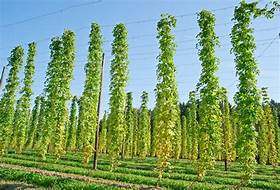
And, now, a step forward to 2018’s Herb of the Year - Hops

Everybody recognizes Hops – a flavoring and stability herb used in beer making which gives it a bitter, zesty, and/or citric flavor.  But, did you know, that hops have been used in beer making since the 9th century.  Prior to that, beer was made with bitter herbs like dandelion, burdock, marigold, horehound, and ivy. 

Hops are the flowers (also called seed cones) of the plant Humulus lupulus.  This plant is a vigorous climbing perennial, usually trained to grow up strings in a hopfield, hop garden or hop yard.  Pretty cool that they have their very own name rather than just “the herb garden”. 

But, hops can also be used in herbal medicine also.  Similar to valerian, as a treatment for anxiety, restlessness, and insomnia, a tea made with hops can bring relaxation and calm.  Though, you should remember that hops is a bitter herb so you will need to add a sweetener like honey or agave nectar.  Fill a dream pillow with hops to encourage pleasant dreams.  Or, boil hops flowers in water and use it as a cleaning agent to promote peace and relaxation in a room.

Hops is a very attractive plant - it needs to grow on something (rather than crawl all over the ground), is very aromatic, and has many uses.  What more could you want!

Growing hops is a little tricky as this plant is a vigorous vine (or as one source calls it – a Bine
because “bines have significant stems with stiff hairs that aid in their ability to climb while vines use suckers or tendrils to attach themselves to surfaces” – ha! another bit of interesting moderately useless information).  They can grow up to a food a day topping out at 25+feet.  They are grown from rootstock or rhizomes.  Hops should be planted with a southern exposure in a light, well-draining soil.  Plant the rhizomes as close together as 3 feet.  Water consistently during the first year.  Harvest the flowers in early fall when the seed cones (flowers) feel dry-ish.

Take care.


Thursday, January 11, 2018

Letters from the Past


I used to write a NEW YEAR LETTER (my version of a Christmas letter – just not written until after the holidays were over and put away).  I came across this one the other day.   I wrote it on 12/31/11, looking back over 2011, which was a very challenging year – one where I was close, a number of times, to running …….


 A year.  A year since Michael’s health deteriorated so quickly.  A year since we struggled to get him in the car for the frantic trip to the hospital.  A year since the young, compassionate and straightforward doctor told me he had been misdiagnosed and had stage four lung cancer that had spread to his spine, ribs and skull.  A year since he came home for the last time.   A year since December 12, 2010 at 6:00pm when Michael took in one last breath and died.

This year, 2011, has been a time of huge change.  The best description is this:  I was unpreparedly snatched up from the world I’ve lived in for the past 60-odd years and dropped into a parallel universe where everything and everyone looked the same, but different.  It has been a – well I can’t even think of a word that is big enough to describe this year - worrisome, extraordinary, distressing, frustrating past words, satisfying, promising, pleasing – is there one word that’s all these things?

Distressing - leaving for work early one cold January morning with everything fine.  Coming home that evening to find an eight-foot spray of water washing across the yard from a burst pipe.  Trying to figure out how to cut the water off without having to shut down the well pump (can’t do it).  Then making arrangements to have someone out early the next morning to fix everything.

Satisfying.  The day I mowed both acres using the riding mower – all by myself.  I bumped all over the yard, ran into a couple of flower beds, nearly got knocked off the mower by a low tree limb, and I’m pretty sure I put new finger grooves in the grips from holding on so tightly but it looked pretty good when it was done. 

Extraordinary.   Well, the sale of the house.  I decided in April to put the house on the market.  “Be patient”, said my realtor, “it could be on the market for 6 months or more.”  That would be fine; it would give me time to adjust to the thought of actually moving.  The house sold two weeks later.

Frustrating – the whole moving process.  Packing, Moving, Remodeling, Painting, Unpacking – I HATE TO MOVE.

Frustrating past Words.  Buying a new house.  Honest to heaven, if I could have jumped through the phone lines and strangled the mortgage people, I would have – several times.  A common reminder from friends during this process was “REMEMBER TO BREATHE”.

Satisfying.  The day I could say, the new house was unpacked and all was out, up, useable, and accessible.  This was only achieved this year of 2011 (as opposed to, oh – 2013) due to the help from friends and family.  Thank you is just not enough to say.

Distressing.  Losing two friends – one that I knew was quite ill and one that came as a shock.  Losing my aunt, my father’s sister – the last of her generation in our family.

Calming.  Visits to and from my children, grandchildren, my sister and brother without whom I would have truly run screaming naked down the street.

And, so, as I look back and then forward, I see change, growth, knowledge.  Obviously, you never get to old for those things.  

Take care


Tuesday, January 9, 2018

Pacific Northwest


The first week I was in Washington it was cold and it rained (or snowed).  Not the pouring down rain I’m used to but more a heavy drizzle.  This is normal weather, I am told.  Fine, I’m from Texas – rain pouring or dripping is not a problem.  Snow - well I don't see it as often but I did live in Colorado for a time, so, not a problem.  However, I will say that it made me v-e-r-y aware of the roads which all go zig-zagging down and on which everyone drives really fast.  When the three of us went anywhere, I was perfectly happy to sit in the back where I could not easily see the road ahead because my brother drives like a bat-out-of-hell!


And, there are waterways everywhere.  Creeks, sloughs, bays, rivers, channels, harbors, lakes, ponds, and sounds.  Everywhere.  And, although I didn’t get into any of those waters, I suspect they are all cold – all the time.  Give me the warm bath tub water south of here call the Gulf of Mexico any day!

The Washougal River

The Columbia - reflecting the sky so it's
had to tell up from down.
The creek in my brothers
back yard.
Columbia Gorge
I was also surprised by the amount of still green plant life (it was in the 30s and 40s, plus it snowed, for heavens sake).  Ferns, rhododendrons (a bigger relative to azaleas), fir trees (not a pine, as I have been told MANY times –which, by the way, is an evergreen coniferous tree in the family Pinaceae – like the pine tree), holly, ivy, blackberry canes, and the ever present orthotrichum (a moss that grows on everything). 
Orthotrichum
Helleboris about to open.
 
Lady Fern
I have to say that, although I’ve seen all sorts of dog houses, I’d never seen calf houses. 


The second week, it was still chilly but the sky cleared up and was beautiful blue.  We went out for some sight-seeing.  Beacon Rock is a huge chunk of rock along the Columbia river.  There is a hiking trail to the top which is open year round.  We didn’t try hiking up though as the wind was blowing so hard, it literally knocked me over while trying to take this picture. 


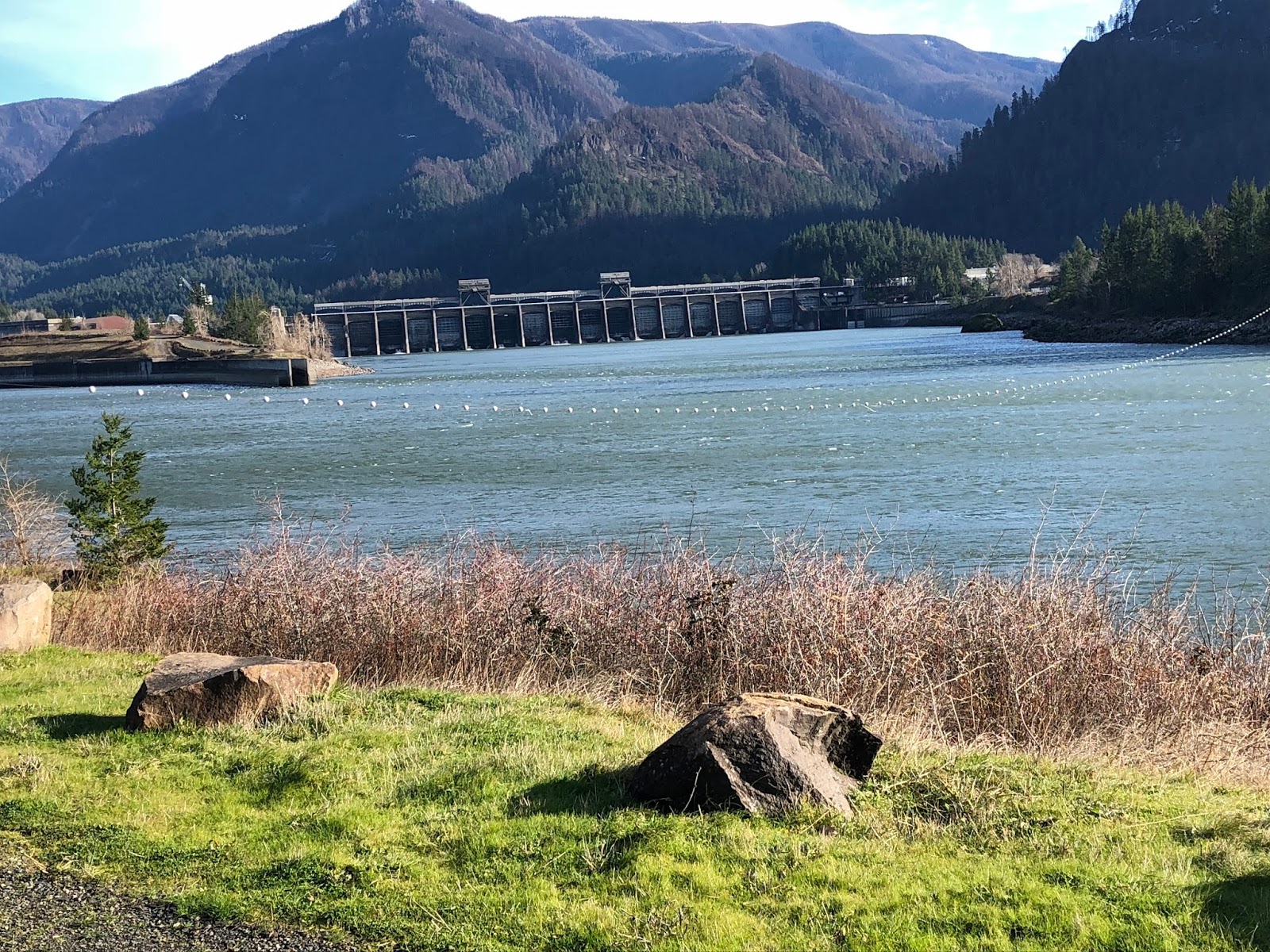
Bonneville Dam.  The first powerhouse, spillway and navigation lock were completed in 1938 to improve navigation on Columbia River and provide hydropower to the Pacific Northwest. A second powerhouse was completed in 1981, and a larger navigation lock in 1993.  Because there was concern about the salmon and their spawning habits, they also have fish ladders.  Interesting.


Fish ladder

Wonderful trip.  Wonderful people.  Good times.


Take care.
Yellow Primrose
OK - one more - Portland Zoo Lights

Monday, January 8, 2018

Northwest


This year I was invited to spend the Christmas/New Year holidays with my brother and his family in Washington.  It was a wonderful trip.

These days they live just outside Camas, WA which is about 20 miles east of Portland, OR. 


OK – just a few “did you knows”..

Camas borders Washougal, WA on the east side and Vancouver, WA on the west – kind of a “tri-city” sort of thing.  It’s hard to tell when you leave one town for another.

Camas is named after the Camas Lily, a plant in the asparagus family native to Canada and the NW United States. An edible plant, the bulbs can be pit-roasted or boiled. A roasted camas bulb looks and tastes something like baked sweet potato, but sweeter (according to those that eat such things).


The roads (at least the roads I saw) are all two-lane, curvy, and steep.  And everyone drives fast.

Camas lays claim to a large Georgia-Pacific paper mill and the high school sport teams are called "the Papermakers".

It’s very close to the Columbia River which is the largest river in the Pacific Northwest.  The river starts in British Columbia, Canada, flows northwest and then south to Washington, turns west to form most of the border between Washington and Oregon and empties into the Pacific Ocean.  This is a big river – B I G.  Like, you need a boat to get across it - big.  Its drainage basin is roughly the size of France. It is the fourth-largest river in the US by volume and has the greatest flow of any North American river entering the Pacific.


Surprisingly, their weather is very similar to here except it’s not so humid or at least it doesn’t feel as humid.  They get about 50 inches of rain – we get about the same.  Their average winter temperature ranges from 45° to 30° F.  So does ours.  However, here the similarities stop.  Our summer heat can start as early as April and last until November with ranges from 100° to 85° (plus an equal amount of humidity).  Theirs starts in August – 90° to mid-40°s and is done by September.  They actually have that whole – spring, summer, fall, winter thing.

They are surrounded by mountains (sez the serious flatlander here). 


More to come …


Take care.