Friday, February 15, 2019

Mornings


In the early morning hours when I first wake up, I tend to plan out my day.  It’s a holdover from working full time in sales and then consulting.  Sort of prioritized my day which made it easier to work in problems or emergencies. 


Of course, now I don’t have the same problems but, I do still plan out the things I want/need to accomplish.  Then, when those things are done – Yea Me! 

Today, my list started and ended with yard work.  We are having early spring these days.  Yes, I know, February.  And, yes, I do expect at least one more drop into the 30’s before all is said and done.  However, the weeds believe it to be spring and are running amok throughout the yard.  I am trying to get the them under control (well, that’s a bit of an oxymoron – control and weeds). 

And I did want to get the Coral Vine cut back to the ground otherwise the new growth would grow over the old and I’d have a massive vine, not only 20 feet long but probably 5 feet tall all along the fence.  Now, I’m the first to admit, it’s pretty and it attracts pollinators but it gets out of control very easily, is invasive, and is happy to grow up trees and onto power lines.  Apparently the seeds and root tubers are supposed to be edible but mostly this is a Federal Noxious Weed, TDA Noxious Weed, and TPWD Prohibited Exotic Species.  I spent several years trying to kill it with no success so finally I gave up and try to keep it pruned.


Coral Vine, (Mexican Creeper, Chain of Love, Queen’s Wreath) is a fast-growing tropical that loves our warm to hot climate.  While it can freeze to the ground, it is happy to come back in the spring and in fact, can grow 10 to 20 feet in just one season.  It has bright pink flowers and big heart shaped leaves and is a pain in the patootie to cut back.  

That done, I moved on to the weeds.  Right now, my yard is full of
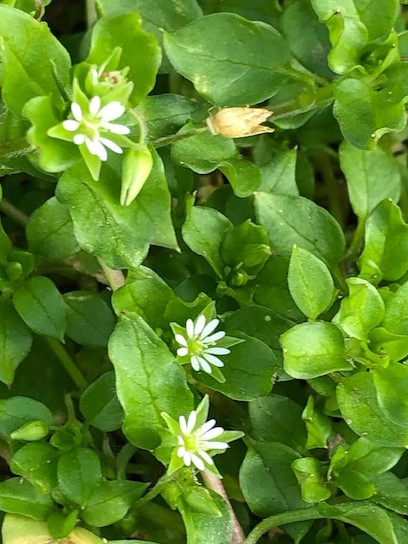


 Chickweed

Wood Violets

10-Petal Anemone


Clover

and
  

Sow Thistle
Aarrrggghhhh!

I’ll bet I spent two hours digging up the Sow Thistle because 1 I hate it; 2 I hate it a lot; 3 It has big prickly stickers and 4 it goes from this size to thigh high overnight.  And, I’ll bet I have at least another two hours of sow thistle digging before the majority of them are gone.  The rest I can deal with - the anemone, clover and chickweed (plus a bunch of others) will die out when it gets hot (which just might be in March).  The violets are just a part of life here in my part of Texas – you gotta love ‘em and go forth.

15 Feb 2019


Saturday, February 9, 2019

Weirdness


It seems there has been a lot of that going on – Weirdness.  Just read the news feeds.  And, then there are these few things --

1 One of the things my sister and I do together is attend estate sales – I’ve mentioned that before.  We went to one this past Thursday.  It was located in Cat Spring, TX (“… a small community, big on family, food and friendships.”). 


Myself – I’d never heard of Cat Spring but according to the info I had, it was only 35 miles north and west. 

In case you want to know – Cat Spring was settled in the early 1800’s by German immigrants.  As of the last census, there is a population of 76.

I think it’s further because it took us an hour to get there via state highways, a tiny bit of I10, county roads which turned into a dirt road and ultimately a mud driveway.  It was one of the more unusual places I’ve been to and if I were to guess, I’d say originally it had been a working ranch (maybe still is).  First of all, the compound consisted of four very large metal buildings.  The first was a huge storage building with all sorts and sizes of tools.  Hmmm.  Interesting.  The second building was divided into two main areas.  One side was a storage (more tools, etc) area; the other a large square room with a very small kitchenette (it held exercise equipment, lots of exercise equipment).  There were a couple of “do not enter” doors that I assume were bathrooms and closets.  Double hmmm.  Building #3 was the largest and was one huge rectangle shaped room including a small kitchenette and the do-not-enter doors.  This was the weird part - Along one long wall were 6-foot bookcases (maybe 20+) and those bookcases held books – hardback books - all sorts of books – fiction, mysteries, romances, historical and self-help, training, textbooks and non-fiction of all sorts (like Billy Graham, Buddha, History of the Atom).  Then, there were five or so bookcases that held DVD’s.  All kinds of movies – action, adventure, drama, documentaries, comedies, scifi, war – all kinds.  The fourth building must have been the main house although it also only had one large square room with a kitchen (I don’t think there was a separate bedroom, though there was a small utility room, large bathroom and closet). 


Very interesting place and if I think about it, it sort-of makes sense – the four buildings and all the books and movies.  The sale itself was not bad – some very nice things, some unusual things, and some “really-why?” things. 

2 So, last night around 7pm, the temperature was hovering at 38°.  Then, when I went to bed around 10pm, I noticed the temperature had risen to 42°.  I know, not a big jump but as the night wore on, it got slightly warmer.  Weirdness.  There was nothing to make it warm up.  The wind had been and continued to blow about 15mph out of the north. 

Then, when I got up this morning, according to weather.com, today . . .

TODAY CLOUDY(yes, and what else is new)
HIGH
43°
20% Humdity

TONIGHT
LOW
44°
10% Humidity


Really?  You’d think the “Low” would be less the high.

Aaannnd tomorrow – it’s going to jump up 30 degrees!

SUN
HIGH
70°
20%
SUN NIGHT
LOW
61°
40%


February in Texas – you just never know how to dress in the morning!


3 Honestly, I swear the past six weeks have been overcast and rainy almost non-stop.  We’ve had about 7 inches of rain since the first of the year.  That may not sound like much but when it’s not raining, it’s HUMID – like 75-80% humid.  That means – it’s really raining – the drops are just hovering in the air rather than falling into the rain gauge.  Nothing dries out!  Arrgh!  I know the sun hasn’t exploded or moved to another galaxy because I’ve seen it very briefly a few times.  I worry that if it doesn’t dry out a bit, the weeds will completely take over the yard and I’ll be lost in the spring weed forest.

4 My brother and family live in a small town in Washington state.  All things considered, winters aren’t so bad – rainy?, yes; chilly?, yes; bone-freezing snow and ice, not so much.  They are actually closer to Portland than, say, Seattle.  My niece posted this today.  (Weirdness is not limited to here.)


“Portlanders made a mad dash to their grocery stores in anticipation of the snow tonight. One of the first things to go was the kale.” Photo courtesy of Jesse Friedman

5 Last but not least, there’s this. 

NOAA has confirmed it: 2018 was the fourth-hottest year on record with 2016 being the hottest in recorded history followed by 2015, and 2017.

I have no hope that 2019 will be any better.  

9 Feb 2019

Sunday, February 3, 2019

Feet, Fats, Hogs and Other Things


OK, I’ve been very quiet the past many days – unheard from by most.  Well, my excuse is that

I injured my foot and the fix is to stay off it (let-me-tell-you, much easier said than done).

Then too, I checked three really good books out from the library and have been curled in my chair, reading (and resting said foot).

And, yes, I could sit at my desk (resting said foot) and write and I had all sorts of good intentions (we all know about those and the road to hell) but just didn’t ever seem to get around to doing just that.

As for said foot, better some days than others.  I am officially ready for the magic wand and enchanted words


and be done with it.

Recently I wrote a piece on soap making.  And, I mentioned that I generally use Lard as the “fats” part in my soap making.  It’s readily available in a handy tub, inexpensive, and makes a very nice white, sudsy, bar of soap.  I also commented that in the way past (like the 1600’s), the fat of choice was Tallow (beef and mutton fats) and that’s just not available at the local grocery store.  Not true, as I recently discovered.


A bit expensive (just enough of the fats would be upwards of $100) but for any purists out there – Tallow is available.  Just an odd piece of somewhat useless information.

Yesterday was Groundhog Day.  Everyone knows that’s the day celebrated in the Northeast to determine when winter will be over.  According to Punxsutawney Phil, who lives in Punxsutawney, PA, he did not see his own shadow and is therefore predicting an early spring.  I’m sure those that live in the frigid, cold, snowy, icy northlands, all had crossed fingers and toes and hoped for a cloudy day. 

So, here’s a bit of (maybe, useless) information (but interesting, non the less)


“Groundhog Day has its roots in the ancient Christian tradition of Candlemas, when clergy would bless and distribute candles needed for winter. The candles represented how long and cold the winter would be. Germans expanded on this concept by selecting an animal–the hedgehog–as a means of predicting weather. Once they came to America, German settlers in Pennsylvania continued the tradition, although they switched from hedgehogs to groundhogs, which were plentiful.”

I think hedgehogs are very cute.  I wish we had them here.


However, I’m not overly familiar with groundhogs – prairie dogs, yes – groundhogs not so much.  So, Did You Know? that

Groundhogs are also called woodchucks or whistle pigs (and how cute is that!).  They eat vegetables and fruits, whistle when they’re frightened or looking for a mate and can climb trees and swim.

“In 1887, a newspaper editor belonging to a group of groundhog hunters from Punxsutawney called the Punxsutawney Groundhog Club declared that Phil, the Punxsutawney groundhog, was America’s only true weather-forecasting groundhog. The line of groundhogs that have since been known as Phil might be America’s most famous groundhogs, but other towns across North America now have their own weather-predicting rodents, from Birmingham Bill to Staten Island Chuck to Shubenacadie Sam in Canada.”

Interesting, yea? no? sort of?  Well, I think it’s interesting.

This just made me wonder – does Texas have a weather predicting animal? 


“Alamo, the longhorn, made his weather prediction on Groundhog Day at the John C. Freeman Weather Museum. Alamo, substituting for a groundhog, predicts an early spring.”
  
Well, we haven’t had any bad winter – don’t tempt the fates, Pamela, an early spring? Ok, that’s fine as long as summer holds out until, oh, July would be good.

And, if you live in someplace where there are no groundhogs or longhorns, you might watch –


Birds flight behavior has been used to gauge how bad the weather is going to be. If they’re flying high, the weather will be good and clear. If they’re flying closer to the ground, it’s thought that the air pressure from a coming storm system is causing them pain at higher altitudes.


The saying goes “When sheep gather in a huddle, tomorrow will have a puddle.” It’s believed that when sheep are crowding together and shielding each other, a storm is on the way.


There are a number of old proverbs concerning the ladybug’s usefulness in forecasting the weather. One such saying goes “When ladybugs swarm, expect a day that’s warm.” On the flip-side, if you see them seeking shelter, cold weather is on the way.


You just never know what unusual facts I have to share!

2 Feb 2019


Saturday, January 26, 2019

Ohmigod!


We are just about out of January – already.  Time goes so quickly.  My youngest middle granddaughter turned 18 yesterday.  She assured me that was correct – she is now, absolutely positively 18 years old.  Personally, I still think someone miscounted the years.

Then, I got to wondering – what exciting interesting things might I have maybe almost missed this month. 

Well!, I didn’t miss this one.  This month as been so J A N U A R Y I S H for us –
rainy,warm,overcast,cloudy,rainy,cool,cold,rainy,overcast,cool,warm,overcast
and did I say rainy???
that I’ve spent more days reading than anything else. 
Book Blitz Month
Make January your Personal Book Blitz month by -
Read the books that are sitting on your shelf that you have been wanting to read. check
Re-read your favorite series. check
Read a book from a new author or an author that your friend recommended. check
Read a book that was made into a movie. check

And, yea!, I didn’t miss this either.  I lean toward being a tea drinker anyway but when it’s cold and damp, a hot cup of tea warms me right up. 
National Hot Tea Month
Peppermint Tea helps to relax the muscles of the digestive tract and reduce spasms.
Passionflower Tea promotes sleep and relaxation, lowers blood pressure.
Black Tea is rich in antioxidants, has few or no calories, has minimal sodium, proteins, and carbohydrates, and is known for its curative qualities


I’m pretty sure the whole world missed this one.   
No Name Calling Week: 21-25

Ok – I had to look this one up.  Someone has too much time on their hands is all I can figure out if they came up with …
Dimpled Chad Day: 4
Noun  1.       dimpled chad - a chad that has been punched or dimpled but all four corners are still attached
chad - a small piece of paper that is supposed to be removed when a hole is punched in a card or paper tape

I certainly hope everyone participated on this day.  If you did miss it, start today.  I included one of my favorite Shel Silverstein poems – hugging is so much better than tugging.
National Hugging Day: 21
Hug O' War By Shel Silverstein

I will not play at tug o' war.
I'd rather play at hug o' war,
Where everyone hugs
Instead of tugs,
Where everyone giggles
And rolls on the rug,
Where everyone kisses,
And everyone grins,
And everyone cuddles,
And everyone wins


OK, well, this one makes me glad we don’t have snow – well, real snow, the kind that is more than 2 inches deep and hangs around for weeks at a time.
Snowplow Mailbox Hockey Day: 23  It was created to give those snowplow drivers a day to have fun.  Here's how to play: See how far you can whack a mailbox with just your snowplow! 20 extra points if you hit it out of the zip code!

And finally, today is
Toad Hollow Day of Encouragement: 26 comes from the legend of Toad Hollow which is rooted in an 1800's school house in Kalamazoo, Michigan and the stories told by Ralph C. Morrison.  Morrison said that Toad Hollow cannot be found on a map, but rather, it's found in your heart.  This is a day to give encouragement and support to others (people you like, and even those you do not).


26 Jan 2019

Monday, January 21, 2019

Soap Making


I mentioned that I’m a soap maker.  I am.  I make soap using a cold process method (rather than melt and pour or hot process but more about those later). 

Not long after moving to Wharton, I became a member of the group that set up, promoted, and managed the Wharton County Farmer’s Market.  Michael sold candied jalapenos (yes, he made them himself), popcorn, eggs, and whatever garden vegetables we didn’t use. 

I sold all things herbal.  Like dried herbs, herbal mixtures, teas, fresh herbs, and so forth.  I also decided to make various herbal lotions, bath products and


soap.  OK – how hard can it be?  Well, after reading various articles on soap making, I was somewhere between slightly confused (saponification?? trace??) and completely intimidated (the glycerol molecule is separated from the fatty acids; fatty acids then react with the hydroxide ions???).  Then, what kind of soap (castile?? tallow?? use mica powders?? fragrance oils vs essential oils??).

OK – is there somebody that could teach me?  Wellllll, no.  So, I pulled on my big girl panties and took the plunge.  First tried making castile soap.  A nice mild soap that is (1) expensive to make (because you use mostly olive oil) and (2) takes a long time to trace.  I actually don’t make that anymore.

Now, in the 1600’s, soap makers used animal fat.  Lard!  Available at the grocery store in a handy dandy package


and a lot less expensive than olive oil and even less expensive than vegetable fats.  And, here’s a

Did You Know?  Lard is made from pig fats, while tallow (which you cannot buy in a nifty package at the grocery store) is made from beef and mutton fats. 

Next – sodium hydroxide (or to history buffs – potash).  Lye.  Here’s another

Did You Know?  You can’t just go to the grocery or hardware store and buy lye – at least not here in Texas.  Not anymore.  You have to order it from the internet. 

Fine.  Next, a couple of molds and I was off and running. 


So, when I was a just-getting-started soap maker, I followed all the prep work to a ‘T’.  Took me as long to get ready as it did to actually make the soap.  Today, while I’m careful (dealing with lye can be dangerous to all parts of your body, not to mention counter tops), I don’t cover everything with 5 layers of newspaper, wear old clothes, or gloves up to my elbows. 

Soap making is actually a precise science.  So, if the recipe calls for distilled water or 12 ounces of lye, you don’t want to use filtered water or 12-ish ozs.  I have my own “soap” tools – bowls, thermometers, spoons, and such that are kept clean and together in the back room.  I never just grab a spoon from my utensil drawer unless I’m going to add it to the soap tool collection.


Now, I’m not going to give a blow-by-blow description of soap making (if you ever want to try it let me know, I’m happy to share my experience).  In a nutshell – you dissolve the lye in water, melt the fats, mix it all together and stir for what will seem like hours until it traces.  Put in whatever additives you might want.  Pour into molds.  Wait.  Demold.  Wait, wait, wait.  Eventually, Ta Da! Soap!  Oh and just in case you want to know . . . . 

SAPONIFICATION is the process that changes fats and sodium hydroxide into soap.  TRACE is the sign that the soap is ready to pour into a mold.  Looks a little like cake batter.

Also, once the soap is in the mold, then demolded and/or cut into bars, using the cold process, it needs to cure 4-6 weeks.  It takes that long for the saponification process to actually complete. 


These are my curing racks.

There are a couple of other options for soap making.  The Melt and Pour method is a good option for beginners and children.  All you have to do is melt the premade base, customize it with your favorite additives, colors and scents, and pour into a mold.  As soon as it cooled, it’s ready to use. 


Another soap making choice, and one I want to try next time I make soap, is Hot Process Soap.  Supposedly the end result is a harder bar of soap.  The method is fairly similar to the one I use now but you “cook” the soap for a long period of time.  Sounds interesting.  I’ll let you know how it works out!


21 Jan 2019

Friday, January 18, 2019

SOAP – root, wort, and yucca


Because I’m a soapmaker and I generally collect all sorts of unusual facts,
Did You Know?
there are at least three native herbs that can produce saponins (a chemical compound found in some plant species that produces a soap-like foam).  Yep, three plants that can make a soapy substance used mostly (in past times) for cleaning and laundry.  You can use them on your own chubby little body but do a skin test first.  Wouldn’t want you to use one of these to wash all over then break out in hives from top of the head to tip of the toe.

Soaproot (Chlorogalum)


 . . . is native to western North America, from Oregon to Baja California.  A member of the Lily family, it grows from a bulb that produces a grey-green wavy or toothed leaf and white, pink, or blue flowers.  The flowers bloom in early summer and oddly, don’t open until afternoon.  They grow best in full sun or light shade (and considering the part of the world they’re native to – here I’d say light shade).  They like fertile soil with good drainage.  It’s easiest to grow them from bulbs.  Like most – plant bulbs in the fall.  You can grow them from seed but according to what I’ve read, it’s a time intensive process that needs a lot of hands-on attention.  They prefer regular watering and benefit from a healthy mulch covering during the winter.


The two species used for their detergent properties by Native Americans and early settlers are C. pomeridianum (it is occasionally known as Wild Potato, even though it lacks any resemblance or relationship to the potato) and the C. angustifolium (a perennial wildflower also known as Narrow Leaf Soap plant).  The juices of the bulb contain the saponins making them useful as a kind of soapy scrubber.

Soapwort (Saponaria officinalis)

Now, I’ve grown this one and the first thing I want to warn you about ---- it can be very invasive so keep that in mind if you decide to plant it.  Also known as Bouncing Bet (Crow Soap, Wild Sweet William, and Soapweed), this is an easy herb to grow.  It can get 1 to 3 feet high and since it cheerfully self-sows, it can be used as a ground cover.  Soapwort produces pale pink to white flowers from midsummer to fall.  Most pollinators are attracted to it.  You can start seeds inside during late winter or after the last frost, sow directly in the garden.  Germination takes about 3 weeks.  It does well in full sun to light shade and is happy in any type of soil as long as it is well draining.  My plants were on the southeast side of my greenhouse – it got a lot of morning and early afternoon sun but not so much of the really hot afternoon and evening sun. 


Now, it you want to make your own liquid soap – take 10-12 leafy stems and add to a pint of water.  Boil for 30 minutes, cool and strain.  The soap only keeps for a week or less so plan to make and use it. 

and finally,

Soaptree Yucca (Yucca elata)

Yucca is a genus of perennial shrubs and trees in the Agavoideae family.  There are something like 50 different species, all notable for their rosettes of evergreen, tough, sword-shaped leaves and large branches of white flowers. They are native to the hot and dry parts of the Americas and the Caribbean.

Some species have adapted to a wide variety of climates from mountains to coastal sand; grasslands to deserts.  Most species have thick, waxy skins to prevent loss of water through evaporation frequently store water in the thick roots.  Some store water in their fleshy leaves.  Some desert plants have an oily coating on their leaves or pads that traps moisture, thereby reducing water loss.  Some drop their leaves during drought to help control the loss of water.  Dead leaves of yucca collecting against the trunk of the trees help protect it from the sun.  And the channeled leaves of a yucca direct dew and rainfall water to their roots.  In general, a very versatile plant.


But we’re talking about the Soaptree Yucca.  The roots of this plant are high in saponins.  This is an evergreen, palm-like shrub or small tree that can grow 10 to 18 feet tall (which in my book does not make it a small anything).  The yellowish, leathery leaves have fine white threads along the edges and end in a sharp spine.  It’s native to the Americas, blooms from middle summer to early fall, and likes full sun and good drainage.  You can grow one from seed although be patient as germination can take anywhere from a month to a year.  It’s drought tolerant and when you do water – do so sparingly – enough to wet the roots, not enough to flood the plant.  And make sure you plant it some place safe – sharp leaves – dogs, cats, small children.  Oh, and it grows well as a container plant.

I suspect few people make soap from the Soaptree Yucca because it is really A LOT OF WORK.  First you need to dig up the Soaptree (no small thing by itself – big, heavy, lots of pointed sharp leaves).  Next, remove all lose dirt from the roots with a stiff brush and then, using a small hatchet, chop the roots into manageable pieces.  Cut off the hair-like extensions and the outer root covering, keeping the new exposed surfaces a clean as possible.  Whack the peeled pieces into small chunks and use a hammer (or a blender) to pulverize the pieces into a pulp.  When the mushy pulp has turned light amber, you can use it as a soap or shampoo.  It has a shelf life so it should be used, dried, or frozen.  Whew! 

Maybe I’ll pass on these soap options.

18 Jan 2019


Thursday, January 17, 2019

Doings (3)


A couple of months ago, my sister wrote that she spent some time, at her home, removing all the window screens, cleaning them, washing windows, and putting everything back together. 

It guilted me into knowing I need to do the same thing.  Now, washing windows fits right up there with vacuuming, mowing, and fixing car problems – not in my job description.  However, over the past many years, it appears my job description has changed so, after rechecking, I found Washing Windows on the list of responsibilities. Ick. 

When I moved into my current house, the window screens were in poor to terrible shape.  I contacted a guy to fix the problem.  He picked up the old screens – good.  I had intended to wash all the outside windows before he got back with the new screens.  Good intentions; road to hell.  I swear, he picked up all the old screens on a Monday and by Tuesday afternoon they were rehung.  No, I didn’t get the windows done.  Sigh. 

So, when I decided to start window cleaning, I was washing 7+ years of general dirt, spider webs, etc.  So far, I’ve gotten the three in the living room done – small start but starting is better than lamenting.  And, it took me longer than I would have thought to do just those three, since it involved moving furniture and then, half a dozen trips inside – outside – inside – outside.  And washing rags – you need a bunch of those since a good swipe removes the dirt onto the rag and if you're not careful, another swipe with the same rag, puts it right back (you can only turn it so often until the whole thing is really dirty - therefore, a bunch needed).  However, it’s well worth the effort. 


Next the windows in my office and dining room!!!!  Of course, today it’s rainy and the rain is supposed to continue through the next two days and then the temperature is going to drop into the very low 30’s.  Oh yes – I know, January, Winter is Coming.


Window washing is on hold.  That’s okay – still have those good intentions!

17 Jan 2019